One Month On Sumatra Floods and Landslides Emergency Response: Notes on Vulnerability and Preparedness
Learning from disaster is a painful process, especially because the choice to learn before catastrophe strikes is always there. There is a wealth of international and national history that can serve as a vital resource for learning. The 2004 Aceh earthquake and tsunami, the 2018 Palu earthquake and liquefaction, the 2002 Jakarta floods, the Sintang floods in West Kalimantan, and Tropical Cyclone Seroja in East Nusa Tenggara in 2021—along with many other disasters—provide a clear foundation for us to stop waiting for tragedy to occur before we begin to learn.
A Surge in Vulnerability During Disasters
Disasters are a primary cause for children and communities to shift from being vulnerable to becoming acutely at risk. Even before a disaster occurs, those in vulnerable groups often lack a safety net in almost every sector of life. When disaster hits, what little they possess is either damaged or lost. Consequently, the lives of these children and communities depend entirely on whatever remains.
Being a vulnerable or "most vulnerable" member of society also means having few, if any, choices. For instance, they cannot choose more environmentally friendly livelihoods, nor can they opt to live in locations safer from hazards. Their daily lives are already precarious. The slightest tremor can jeopardise their fundamental rights; and a disaster is no mere tremor.
From 25 to 30 November 2025, floods and landslides struck three provinces in Sumatra: Aceh, North Sumatra, and West Sumatra. As of the time of writing (27 December 2025), the National Disaster Management Agency (BNPB) has recorded over 1,000 fatalities and more than 450,000 displaced persons. Within these statistics are vulnerable children and citizens who have become the most vulnerable. Children are the primary group at risk, followed by women, and then persons with disabilities and the elderly.
The soaring levels of vulnerability during such disasters make emergency relief support both vital and urgent. The lives of affected survivors must be carefully protected so they can endure amidst such loss and destruction. This end-of-year period marks one month of the flood and landslide response in Sumatra. At a time usually filled with celebrations, children and communities in Sumatra need continued support so they can once again feel hope and joy in the aftermath of the disaster.
To help ease the burden on survivors, as of 27 December 2025, Wahana Visi Indonesia (WVI) has achieved the following:
Distribution of Non-Food Items
-
300 under-2 kits across 7 displacement camps.
-
234 school kits across 2 displacement camps.
-
96 family hygiene kits in one affected village.
Clean Water and Sanitation
-
34,000 litres of clean water distributed.
-
9 water tanks deployed at displacement camps and public facilities.
-
310 metres of piping installed to restore clean water access.
Psychosocial Support
-
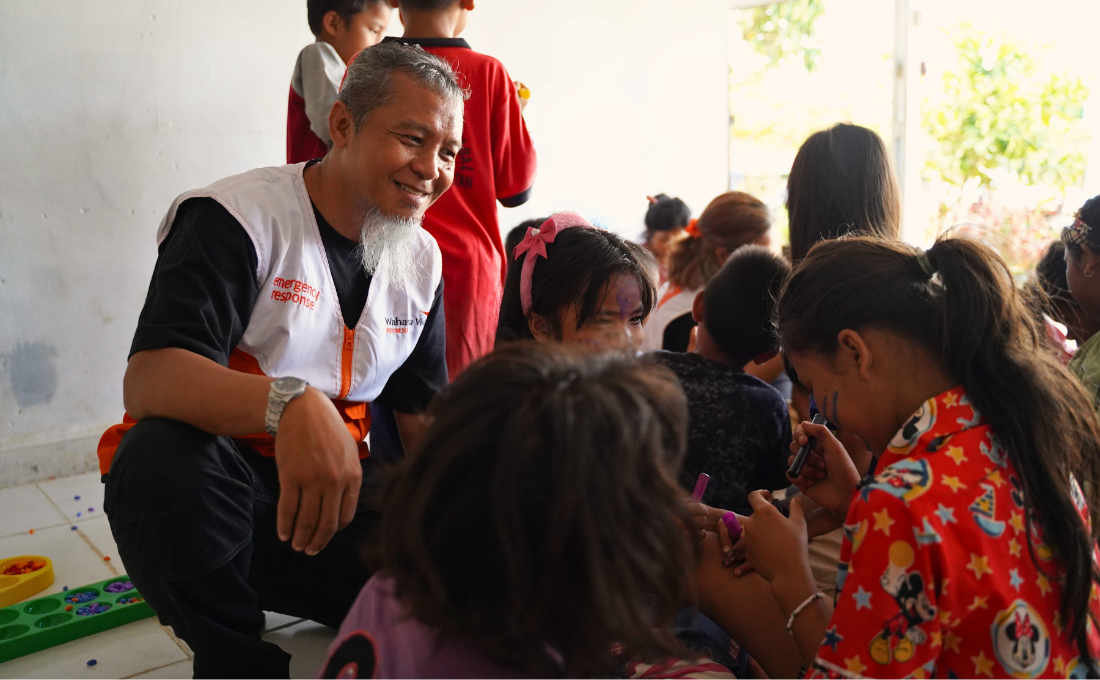
397 children engaged in Child-Friendly Spaces.
-
20 psychosocial support facilitators trained to lead activities.
-
One Child-Friendly Space tent established at a displacement camp.
Nutritional Support for Toddlers
-
5,032 nutritious meal packs for 222 toddlers across 4 displacement camps.
In this first month, WVI is focusing on the health of toddlers and children. Therefore, activating specialised kitchens to provide nutritious meals for toddlers is a core priority, alongside providing access to clean water. We must ensure these floods and landslides do not lead to a secondary disaster of malnutrition for the affected children.
"We feel a responsibility to do this (the specialised kitchen for toddlers). We can imagine how the displaced people in the camps feel, which is why we want to help cook here. Even though our own houses are damaged and our belongings were destroyed by the water," said Nella, a member of the Nutrition Fulfilment Service Unit (SPPG) in Central Tapanuli Regency. Nella is a volunteer in the kitchen providing nutritious meals; she is also a mother and a survivor herself. When the floods arrived, she and her child sought refuge in a nearby school building.
Aid—whether in the form of goods, programmes, or the time and effort of volunteers—is essential and urgent so that children and communities can quickly rise and recover. While many sincere hearts have stepped forward to help Sumatra, this disaster should also serve as a lesson, ensuring that children and communities are more empowered and prepared for the future.
Preparedness: A Form of Protection and Empowerment
Disasters cause losses far greater than the investment required to build community preparedness. These losses are measured not only in material terms but also in environmental destruction and the loss of human potential. The costs of emergency relief, rehabilitation, and post-disaster recovery are immense. Furthermore, disasters striking unprepared populations cause profound social shocks and the loss of countless opportunities for children and their communities.
"These floods and landslides felt like a nightmare because they had never happened before. The water receded briefly, but a few hours later, a powerful current returned, carrying huge logs. Houses and rice fields were destroyed. Now, whenever it rains, we are terrified," says Mardia, a survivor of the Sumatra floods and landslides in November 2025. Her village in Central Tapanuli was one of the worst-affected areas in the regency. Her grief is overwhelming as she recounts how the debris flow swept through her village.
If investment in preparedness becomes a priority, it will not only save money but also ensure that children and communities are better protected. The social and economic disruption would not need to be as catastrophic as what the people of Sumatra are currently enduring.
Building preparedness must begin at the village level, involving the most vulnerable children and community members through a long-term community development approach. WVI applies this method to establish Disaster Resilient Villages. Community-based preparedness sparks awareness, drives change, and guarantees safety when disaster strikes.
Local government, community leaders, healthcare workers, educators, women’s groups, youth organisations, and other village groups must draft plans and share responsibilities to minimise losses. When these systems are in place, early warning systems are activated. Children, persons with disabilities, and the elderly—who are amongst the most vulnerable—can be better protected. Livestock and harvests are moved to safety. Displacement camps are pre-arranged. Emergency aid, such as regular kitchens and specialised kitchens for toddlers, can function immediately. Everything is ready and waiting so that once the disaster passes, the wheels of life can begin turning again.
The looming threats of climate change and environmental degradation serve as an alarm to prioritise disaster preparedness further. The Meteorology, Climatology, and Geophysical Agency (BMKG) has stated that Indonesia is no longer safe from tropical cyclones. Climate change, which causes atmospheric anomalies, has led to Indonesia being increasingly hit by tropical cyclones over the last five years—including Tropical Cyclone Senyar, which triggered the floods and landslides in Sumatra.
Another alarm for the Indonesian public is the Sunda Strait Megathrust. The National Research and Innovation Agency (BRIN) has warned that this potential threat is no longer a matter of if, but when. The southern coastal areas of Java must urgently increase their preparedness for this eventuality.
Indonesia must also raise awareness regarding environmental conservation. The Sumatra floods and landslides have raised many questions and warnings about excessive environmental exploitation. The combination of climate change, which increases the frequency and risk of disasters, and environmental damage will inevitably lead to disasters with massive impacts.
Extension of the Disaster Response Period
WVI is extending its disaster response period for the Sumatra floods from three to six months. The response is now scheduled to conclude in June 2026 and will cover areas across North Sumatra and Aceh. Future programming will expand into the economic and education sectors while maintaining a steadfast focus on children.
In tandem with these efforts, WVI continues to advocate for the vital importance of building disaster preparedness among children and communities. There is an immense urgency for tangible action in disaster risk reduction. Children and communities across Indonesia must adapt to climate change and become empowered in disaster risk management. This reflects our ongoing commitment to ensuring the well-being of Indonesia’s children and society.
Author: Mariana Kurniawati (Communication Executive)
Reviewer: Sumatra Floods and Landslides Emergency Response Team